Enova Q3 2026 Earnings: OnDeck and Headway Parent Posts First $1 Billion Quarter, and the Stock Still Fell 7%
2 hours ago
5 min read
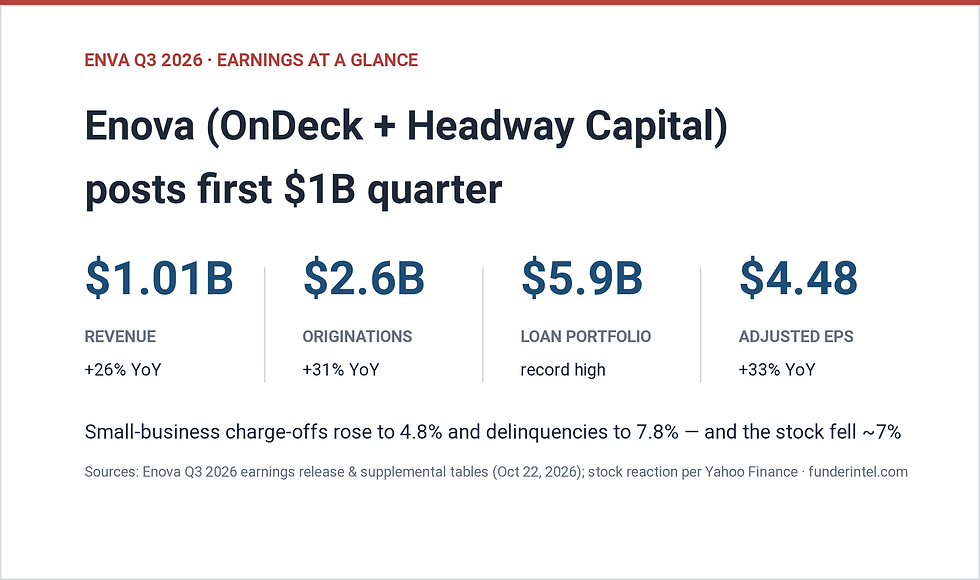
Enova International (NYSE: ENVA), the parent company of small-business lenders OnDeck and Headway Capital, reported its third-quarter 2026 results after the close on October 22, and it was a record revenue quarter: revenue crossed $1 billion in a single quarter for the first time, originations grew 31%, and the loan book ended at a record $5.9 billion (earnings release).
The stock still dropped roughly 7% on the first full trading day after the print (Yahoo Finance), after a three-month stretch in which shares had already fallen sharply.
Behind the record revenue, Enova's supplemental tables show small-business charge-offs and delinquencies rising year over year, while consumer credit metrics improved (supplemental tables). Shares fell after the release, and contemporaneous commentary raised concerns about credit seasoning; the materials reviewed do not establish a single cause for the decline. Here's the full picture.
The headline numbers
Enova beat Wall Street expectations on both lines: adjusted EPS of $4.48 versus a $4.42 consensus, and revenue of $1.01 billion versus roughly $1.00 billion expected (MarketBeat).
Metric | Q3 2026 | Q3 2025 | Change |
Total revenue | $1.009B | $803M | +26% |
Net revenue | $614.4M | $460.7M | +33% |
Net revenue margin | 61% | 57% | +4 pts |
Net income | $107.3M | $80.3M | +34% |
Diluted EPS | $4.06 | $3.03 | +34% |
Adjusted EPS | $4.48 | $3.36 | +33% |
Adjusted EBITDA | $268.6M | $217.7M | +23% |
It was Enova's 12th consecutive quarter of at least 20% year-over-year originations growth, and adjusted EPS has now grown at least 30% for nine straight quarters (earnings call).
Small-business lending
Enova doesn't break out OnDeck and Headway Capital as separate brands. It reports them together as its "small business" segment. That segment is now the engine of the company: 68% of the total portfolio.
Per the company's supplemental tables (Enova IR):
Segment | Q3 2026 | Q3 2025 | Change |
Small-business originations | $1.760B | $1.372B | +28% |
Consumer originations | $807M | $590M | +37% |
Small-business receivables (ending) | $3.985B | $2.974B | +34% |
Consumer receivables (ending) | $1.913B | $1.547B | +24% |
Small-business revenue | $459M | — | +32% |

Within consumer originations, line-of-credit products ($570 million) far outpaced installment loans ($237 million), and management noted consumer customers continue to prefer lines of credit, a preference that has persisted over time (earnings call). Company-wide, line-of-credit accounts are now 57.6% of the average combined balance, up from 55.8% a year ago, while installment loans fell to 42.4% from 44.2% (earnings release).
Credit quality: the nuance behind the selloff
This is where the quarter's story really sits. The consolidated numbers look fine, net charge-offs of 8.1% of average balances, improved from 8.5% a year ago. But that improvement was driven entirely by the consumer book. The small-business numbers moved the other way:
Credit metric | Q3 2026 | Q3 2025 | Change |
Consolidated net charge-offs | 8.1% | 8.5% | −0.4 pts |
Small-business net charge-offs | 4.8% | 4.4% | +0.4 pts |
Consumer net charge-offs | 15.1% | 16.1% | −1.0 pts |
30+ day delinquencies, consolidated | 8.0% | 7.2% | +0.8 pts |
30+ day delinquencies, small business | 7.8% | 6.2% | +1.6 pts |
Source: Enova earnings release and supplemental tables. Charge-off rates are quarterly, net of recoveries, as a percentage of average balances; delinquency rates use period-end balances.

So in dollar terms: small-business charge-offs net of recoveries rose from $128 million to $186 million year over year, and the delinquent small-business balance grew from $185 million to $309 million. Management described the 4.8% small-business charge-off rate as unchanged sequentially and within a tight range over the past 12 quarters (earnings call).
Management's defense, laid out by CEO Steve Cunningham and Scott Cornelis on the call: small-business borrowers often have multiple ways to cure late payments: collecting their own receivables, using other payment options, or paying while technically remaining in a delinquency bucket. So SMB delinquency rates are noisy quarter to quarter and, per Cornelis, not reliable predictors of future charge-offs (earnings call). Management attributed the sequential drift to typical seasonality and said company-estimated premiums of fair value over principal on the receivables were stable or improving, reflecting seasoning along expected lifetime loss curves.
So why did the stock fall?
No single cause is established by the materials, but the ingredients for a credit-driven selloff were all visible:
Small-business credit drifted up year over year, charge-offs 4.4% to 4.8%, delinquencies 6.2% to 7.8% (supplemental tables), at the same time small-business receivables are compounding faster than consumer (up 34% versus 24%) and now make up two-thirds of the portfolio. Contemporaneous coverage framed the bear case this way: rapid expansion could stretch underwriting as newer cohorts season (Yahoo Finance).
Marketing spend jumped to 23% of revenue ($230 million) from 18% a year ago — growth is being bought, at least partly. Management guided Q4 back to around 20% (earnings release; earnings call).
Consumer net revenue margin is expected to compress toward roughly 50% as recent vintages season, from currently elevated levels (earnings call).
The sequential rise in small-business delinquencies (management cited 40 basis points quarter over quarter) landed in a quarter where investors are re-examining every lender's credit book (earnings call).
The tension: management's own commentary presents the same data as stable-to-improving, and the consolidated charge-off ratio genuinely improved (earnings release). What the results do establish is mixed credit performance — small-business indicators up, consumer indicators down — alongside record growth.
What Enova Q3 2026 earnings means for small-business borrowers
Here's the practical read:
Growth is not slowing on its own. Management reported continued strong demand, guided Q4 to roughly 25% revenue growth and 30–35% adjusted EPS growth, and said it is not materially changing its industry exposures, although it is watching trucking and construction closely because of trade and tariff exposure (earnings call).
Funding capacity is ample. Enova ended the quarter with $1.3 billion of liquidity ($508 million in cash and marketable securities plus $817 million of available facility capacity), completed the largest term securitization in OnDeck's history during the quarter at a tighter credit spread than a year earlier, and added more than $350 million of facility capacity since Q2. Cost of funds fell 60 basis points year over year to 8% (earnings call).
Watch small-business payment performance. The reported delinquency increase, 6.2% to 7.8% year over year, warrants monitoring in subsequent results (supplemental tables). These disclosures do not establish whether OnDeck or Headway changed approval standards, borrower pricing, or credit limits.
Bottom line
Enova reported record revenue and receivables, alongside mixed credit performance. Small-business net charge-offs rose from 4.4% to 4.8%, and small-business delinquencies increased from 6.2% to 7.8% year over year, while consumer credit improved (supplemental tables). For OnDeck and Headway readers, the key distinction is strong lending growth alongside rising small-business credit indicators — not proof of a broad change in borrower access.
Note: Enova reports OnDeck and Headway Capital together in its small-business segment; brand-level financials are not separately disclosed. This article is for informational purposes and is not investment advice.