Small Businesses Are Confident, Cash-Strapped, and Bypassing Banks: OnDeck & Ocrolus Q1 2026 Trend Report

If you want to know what's actually happening on the ground in small business America right now, the Q1 2026 Small Business Cash Flow Trend Report, published jointly by OnDeck and Ocrolus, is one of the more useful reads on the table. The tenth iteration of this ongoing partnership combines OnDeck's market position as a leader in small business lending with Ocrolus' document AI and cash flow analytics platform, drawing on responses from 651 small business owners and cash flow data from over 3.69 million working capital applications.
The result lands on five themes that anyone funding small businesses needs to pay attention to. Here's what the data says, and what it actually means.
1. Confidence Is at an All-Time High
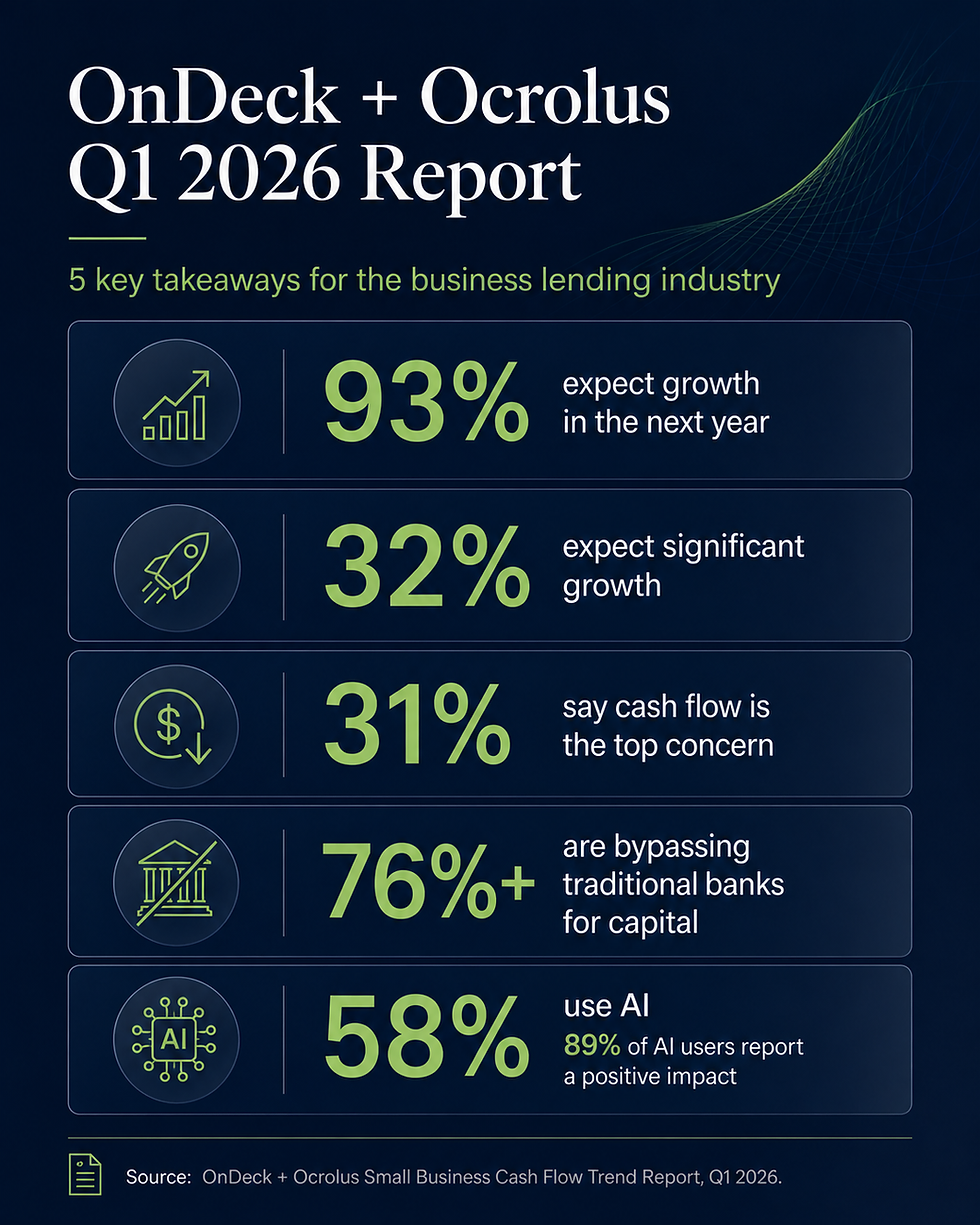
Despite the macro noise, small business owners are remarkably bullish. 93% expect moderate to significant growth over the next year, and 32% are expecting significant growth, a survey all-time high.
Optimism is broad-based, but the leaders are Professional and Technical Services (37% expecting significant growth) and Retail (33%). That confidence isn't unfounded: 68% of small businesses report being on track to meet or exceed their 2026 projections, and 38% plan to increase headcount in the next six months.
This is happening even as the NFIB Small Business Optimism Index dipped to 95.8 in March 2026, below the historical 98-point average. Translation: macro indicators are wobbling, but the businesses actually doing the work are still moving forward.
2. Cash Flow Has Overtaken Inflation as Public Enemy #1
For the first time in this report's history, cash flow is the top concern for small business owners (31%), surpassing inflation (29%).
That shift matters. Inflation is something businesses adapt to over time. Cash flow is an immediate operational constraint. And the data backs up what owners are saying: the median revenue-to-expense ratio across all industries dropped to 99.84% in Q1 2026, meaning the average small business is operating at a slight loss on a monthly basis. Margins are tightening.
The strategies businesses are using to manage the squeeze tell the story:
58% are relying on a business line of credit
51% are delaying paying themselves or their family
42% are making the minimum payment on credit cards
Layer in payroll-to-revenue rising to 17% in Q1 (+5% year-over-year), and you get a clear picture: labor costs are climbing, margins are compressing, and short-term liquidity tools are doing the heavy lifting.

3. Traditional Banks Are Losing the Small Business Customer
This one's seismic. Over 76% of small businesses report bypassing traditional banks for capital, another all-time high. In Retail, that number jumps to 82%.
Why? The data is unambiguous:
44% of small businesses that approached a traditional bank first were denied
47% of those who bypassed banks cite paperwork as a key challenge
33% point to complex application requirements
29% point to lengthy approval timelines
30% had concerns about even qualifying
The Federal Reserve's 2025 Small Business Credit Survey reinforces the pattern: 48% of credit applicants in 2025 were either denied or didn't receive the full amount they requested.
Ocrolus cash flow data shows non-bank loan inflows reaching $8,824 in median monthly volume in Q1 2026, up 5% year-over-year and 2% quarter-over-quarter. Bank inflows trail at $6,929 and remain more variable.
The takeaway: the customer migration from traditional banks to non-bank lenders is no longer a trend. It's the new baseline.

4. The Strategic Priorities Are Clear
When asked what's shaping their 2026 strategy, small business owners ranked:
Access to credit (46%)
Consumer spending trends (42%)
Interest rates (35%)
External macro factors like trade policy ranked far lower at 14%. What this tells us: small businesses aren't building strategy around political headlines. They're building it around whether they can fund growth and whether their customers are still spending.
That's a useful signal for funders; it confirms that the products that win in 2026 are the ones that solve for capital access first and operational flexibility second.
CAPITAL AFTER HOURS
May 14, 2026, 6:30 – 8:30 PMThe Federal
Register Now
5. AI Is Officially Mainstream for Small Business
58% of small businesses now report using AI (up from 56% in Q4 2025), and 89% of users say it's having a positive impact on their business.
Where AI is working:
Marketing (64% of AI users)
Business research (43%)
Productivity gains (37% report improvements)
Reduced rework (37% report improvements)
A growing 54% majority are using AI to search for information, with ChatGPT (90%) dominating, followed by Google Gemini (33%) and Microsoft Copilot (21%).
For lenders, the implication is straightforward: small business owners are increasingly comfortable with AI-driven tools. The friction around digital underwriting, AI-powered onboarding, and automated decisioning is dropping fast.
What The OnDeck & Ocrolus Q1 2026 Trend Report Means for Funders and Lenders
Three takeaways worth marking down:
Demand is real, and it's here. Confidence is at record highs, growth is being planned and funded, and headcount is expanding. The market is active.
Banks are still creating the gap, and that gap keeps widening. Three out of four small businesses are skipping banks entirely. That's where alternative finance, RBF, MCAs, factors, and specialty lenders are picking up share, and the data suggests this isn't reverting.
Cash flow is the central battlefield. The product that solves a small business owner's daily liquidity problem, fast, flexible, and without paperwork, wins their loyalty. That's where attention belongs.
The trend report is one of the cleanest snapshots of small business reality available right now, and it points to a customer base that knows what it needs and increasingly knows where to get it.