

Enova's Bold $369M Grasshopper Bank Acquisition: The Bank Charter Advantage

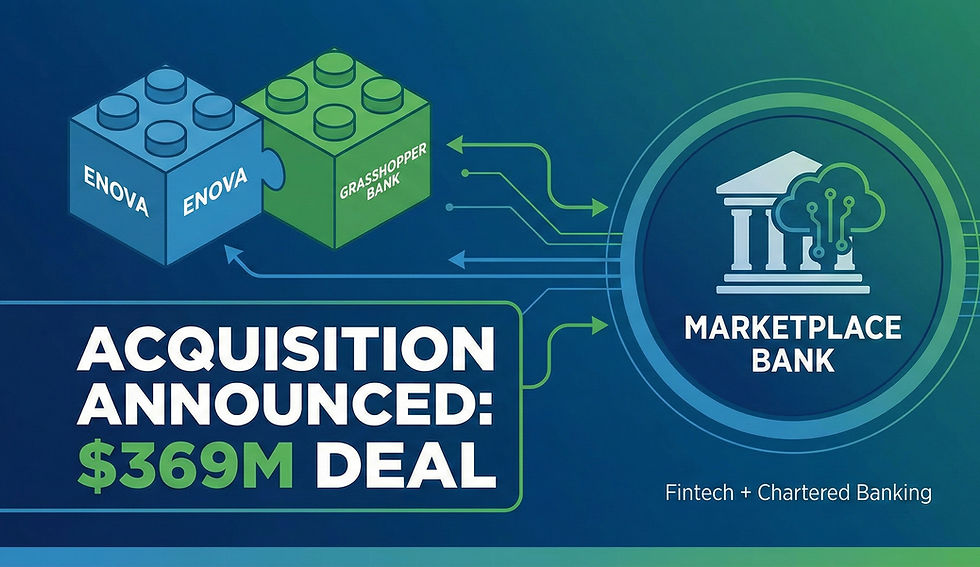
In a bold strategic move that could reshape the alternative lending landscape, Enova International (NYSE: ENVA) announced today it has entered a definitive agreement to acquire Grasshopper Bank for approximately $369 million in a cash-and-stock transaction. The deal unites one of the nation's leading online lenders with a cutting-edge digital bank, creating a financial services powerhouse uniquely positioned to serve underserved consumers and small businesses.
Enova Transaction Overview
The acquisition brings together two complementary fintech innovators. Enova, a Chicago-based online lending giant with over 20 years of experience and more than $65 billion in loans originated to over 13 million customers, will acquire Grasshopper Bancorp, Inc. and its wholly owned subsidiary, Grasshopper Bank N.A.
Founded in 2019, Grasshopper Bank has rapidly grown into a client-first digital banking platform with $1.4 billion in total assets and approximately $3 billion in deposits as of September 30, 2025. The New York-based bank specializes in Banking-as-a-Service (BaaS), API banking platforms, commercial lending, SBA loans, and consumer banking services.
The transaction is expected to close in the second half of 2026, pending Grasshopper shareholder approval, regulatory approvals from the OCC and Federal Reserve, and other customary closing conditions. Following the close, Grasshopper Bank will operate as a bank subsidiary of Enova, which will become a newly formed bank holding company.

Market Reaction: Stock Surges on Strategic Vision
Investors enthusiastically embraced the news, sending Enova's stock soaring. The company's shares jumped to a new 52-week high of $151.94 during today's trading session, up approximately 11% from yesterday's close of $141.40.
This sharp rally reflects Wall Street's confidence in the strategic rationale behind the deal. Over the past year, Enova's stock has delivered remarkable returns of 47.48%, significantly outperforming the S&P 500's 17.09% gain. The company's market capitalization now stands at approximately $3.76 billion, solidifying its position as a mid-cap financial services leader.

What This Means for the Business Lending Industry
This acquisition represents far more than a simple consolidation play; it's a strategic transformation that addresses critical pain points in the business lending ecosystem.
1. The Bank Charter Advantage: Navigating New State Regulations
Perhaps the most significant aspect of this deal is Enova's acquisition of a national bank charter. For years, alternative lenders have operated in partnership with banks or under state-by-state licensing regimes. This acquisition changes the game by allowing Enova to:
Offer centralized, scalable lending and deposit products directly through a national bank charter
Expand its geographic footprint and product offerings across more states
Simplify regulatory compliance and operational complexity
Access more diverse and potentially lower-cost funding sources through deposit-taking capabilities
The Texas HB 700 Exemption: A Case Study in Strategic Timing
The timing of this acquisition is particularly strategic given the rapidly evolving state regulatory landscape. Texas House Bill 700, which took effect on September 1, 2025, exemplifies the regulatory challenges facing non-bank lenders. The law imposes stringent requirements on providers of commercial sales-based financing, including merchant cash advances and revenue-based loans:
Mandatory registration with the Texas Office of Consumer Credit Commissioner
Comprehensive disclosure requirements for transactions under $1 million
A near-impossible requirement that providers hold a first-priority perfected security interest in merchant deposit accounts before using ACH debits
Potential civil penalties of $10,000 per violation
However, HB 700 includes a critical exemption that applies to "a bank, out-of-state bank, bank holding company, credit union, federal credit union, out-of-state credit union, or any subsidiary or affiliate of those financial institutions."
By becoming a bank holding company through the Grasshopper acquisition, Enova would be exempt from HB 700's burdensome requirements and from similar laws being enacted in states like California, Utah, and Louisiana. This exemption allows bank-affiliated entities to:
Continue using ACH debit mechanisms without the first-lien requirement that has rendered many MCA programs operationally impossible in Texas
Avoid state-by-state registration and disclosure requirements that add significant compliance costs
Operate with greater regulatory clarity and reduced legal risk
Maintain operational flexibility that non-bank competitors have lost
Texas is not alone in this regulatory trend. At least nine other states have enacted commercial financing disclosure laws since 2018, with more expected to follow. As this patchwork of state regulations grows more complex and restrictive for non-bank lenders, the strategic value of a bank charter becomes increasingly clear.
David Fisher, Enova's Chairman & CEO, emphasized this point: "Acquiring and partnering with Grasshopper creates a powerful digital bank that positions us to offer a more comprehensive suite of financial solutions across more states to empower consumers and small businesses with the products they need to succeed."
While management hasn't explicitly cited regulatory arbitrage as a driver of the deal, the competitive advantage is undeniable. As non-bank competitors face mounting compliance costs and operational restrictions in key markets like Texas, Enova's bank charter creates a regulatory moat that will be difficult for competitors to replicate.
2. BaaS and API Banking: The Future is Here
Grasshopper's expertise in Banking-as-a-Service and API banking platforms adds a new dimension to Enova's capabilities. The BaaS model has become increasingly important as fintech companies seek banking infrastructure without building it from scratch. This acquisition positions Enova to:
Serve fintech partners looking for banking infrastructure
Generate fee-based revenue streams beyond traditional lending
Leverage technology to scale more efficiently
Tap into the growing demand for embedded finance solutions
3. Small Business Lending Gets a Boost
Enova has been a powerhouse in small business lending, particularly after its 2020 acquisition of OnDeck. The company's small business segment has shown remarkable growth, with small business offerings representing approximately two-thirds of Enova's total loan portfolio of $4.3 billion.
Recent data shows that 76% of small businesses now prefer non-bank lenders for their speed and convenience, an all-time high. This trend plays directly into Enova's strengths. By adding Grasshopper's SBA lending capabilities and commercial banking products, Enova can offer a more complete suite of solutions to its small business customers.
Jim Granat, who leads Enova's small business operations, has built a formidable operation through brands like OnDeck, Headway Capital, and The Business Backer. The addition of Grasshopper's capabilities will only strengthen this position.
4. Funding Diversification and Balance Sheet Strength
One of the most compelling strategic benefits is funding diversification. Alternative lenders have traditionally relied on credit facilities, asset-backed securitizations, and warehouse lines to fund their loan originations. By acquiring a bank with $3 billion in deposits, Enova gains access to a more stable, diversified funding base.
Steve Cunningham, Enova's CFO (who will become CEO effective January 1, 2026, and will also serve as CEO of Grasshopper Bank post-close), noted: "The additional scale and diversification from this transaction should meaningfully enhance our balance sheet strength and flexibility, leading to substantial revenue and funding synergies and significant EPS accretion."

The Numbers: Compelling Financial Accretion
Enova has set aggressive but achievable financial targets for the acquisition:
More than 15% adjusted EPS accretion in the first year post-closing
More than 25% adjusted EPS accretion once synergies are fully realized beyond the first year
These projections suggest significant cost savings and revenue opportunities from combining the two platforms. Given Enova's track record of successful integrations, including its 2020 OnDeck acquisition, management has earned credibility in executing on merger synergies.
The $369 million purchase price appears reasonable given Grasshopper's $1.4 billion in assets and $3 billion in deposits. The deal values the bank at approximately 26% of assets, which is in line with or below typical bank acquisition multiples in today's market.
Competitive Positioning: Building a Moat
This transaction positions Enova uniquely in the competitive landscape. Few companies can match the combination of:
Advanced analytics and machine learning capabilities for credit underwriting
A national bank charter for regulatory flexibility and funding access
Scale in both consumer and small business lending with a diversified product portfolio
BaaS infrastructure to serve the broader fintech ecosystem
Two decades of experience serving non-prime and underserved borrowers
Competitors in the online lending space and regional banks pushing into digital will need to respond to this new competitive reality.
Leadership Continuity and Cultural Integration
The deal includes thoughtful leadership planning. Mike Butler, Grasshopper's current CEO, will remain as President of Grasshopper Bank, reporting to Steve Cunningham. This structure preserves institutional knowledge while integrating Grasshopper into Enova's broader strategic vision.
Cunningham's elevation to CEO of both Enova and Grasshopper Bank reflects his deep understanding of the company's operations and the strategic importance of this acquisition. With Cunningham at the helm, investors can expect disciplined execution and a focus on delivering the promised synergies.
Risks and Considerations
While the strategic rationale is compelling, several risks warrant attention:
Regulatory Approval: Bank acquisitions face intense regulatory scrutiny. The OCC and Federal Reserve will carefully evaluate Enova's readiness to operate as a bank holding company.
Integration Complexity: Combining a fast-paced lending operation with a regulated bank presents cultural and operational challenges.
Economic Sensitivity: Both consumer and small business lending are cyclical. A recession could impact asset quality and profitability.
Execution Risk: The promised 15-25% EPS accretion depends on successfully realizing synergies and growing the combined business.

The Road Ahead
With the transaction not expected to close until the second half of 2026, Enova and Grasshopper have substantial work ahead. Regulatory filings, shareholder votes, and integration planning will dominate the coming months.
However, the strategic vision is clear: create a digital-first financial services company that combines best-in-class lending technology with the infrastructure and capabilities of a modern bank. If successful, Enova will have positioned itself as a leader in the next generation of financial services, one that serves the underserved with speed, transparency, and innovation.