

InKind Raised Another $414M. If You Fund Restaurants, Read the Repayment Structure.
Brief: InKind's $414M round led by Citi pushes its six-month total past $1 billion, funding restaurants through pre-sold dining credit instead of loans or equity.
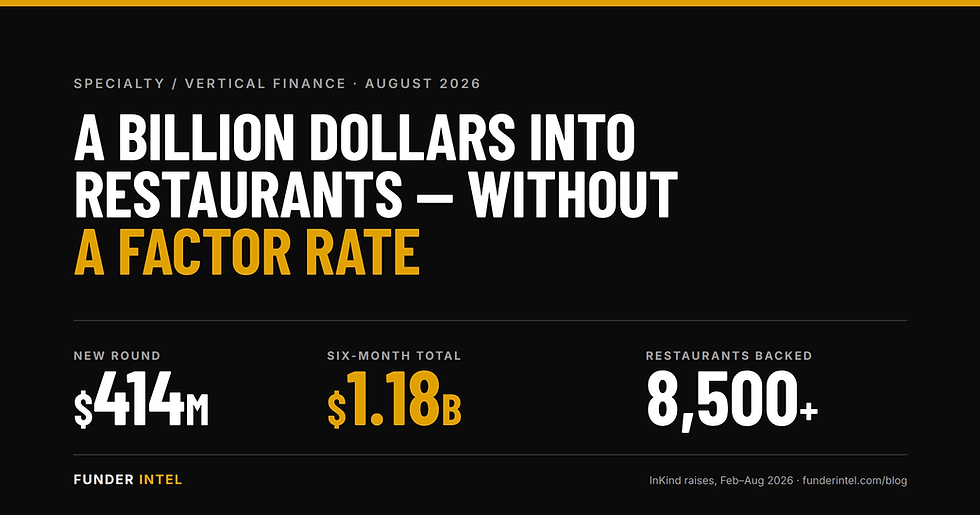
Citi and Cross River led a $414 million round into InKind, announced August 10. That lands one month after $320 million from Liberty Mutual Investments and six months after a $450 million debt-and-equity raise led by Magnetar, more than $1 billion into a single restaurant funding platform inside six months.
The company has deployed over $600 million to more than 8,500 restaurants and wants to back another 10,000 in the next year. In July alone it pushed out $60 million and signed 1,000 new restaurants, a milestone that took seven years to hit the first time.
Restaurants are a core MCA vertical. Card-heavy, thin-margined, chronically short on working capital, and used to expensive money. Somebody just raised a billion dollars to take the top of that funnel, and the product doesn't have a factor rate.
How the money actually moves
InKind buys dining credit, generally at 2-to-1. A restaurant takes $500,000 and hands over $1 million in future credit. InKind sells that credit to consumers at a discount through its app, say $750,000, and diners redeem it over a term that typically runs 12 to 48 months.
No equity. No interest rate. No fixed daily payment. The restaurant "repays" by serving food it was going to serve anyway.
The economics only work if the restaurant stays open, so InKind underwrites hard. An internal AI tool called Sherlock has been scoring applicants since 2023, and Moonesinghe is blunt that failing it means no deal at all. Just under 3% of restaurants it has backed since 2015 have closed, against a roughly 15% one-year closure rate in the broader accommodation-and-food-service category per BLS data.
Checks run from $5,000 to $12.5 million. One group has taken $30 million with another $30 million committed. And 96% of funded restaurants come back for more.

The part that should worry your underwriting
Here's what nobody's saying out loud.
A restaurant carrying InKind credits has pre-sold a chunk of its future sales at roughly half of face value. When those diners walk in and pay with app credit, the kitchen produces full-cost food, and the register collects nothing. That's not a debit on the bank statement. It's not a UCC filing. It's not on a credit report.
It's margin that already belongs to somebody else.
Now run your normal file. The $500,000 lump sum landed as a deposit, so trailing average monthly volume looks better than the restaurant's real run rate. Deposit count and consistency look fine. There's no competing daily debit to spot. Every heuristic in a standard MCA scan says this merchant got stronger, when the truth is a meaningful slice of forward revenue is spoken for.

What it signals
Citi spent 18 months getting comfortable with this deal. Liberty Mutual and Magnetar got there before them.
Institutional capital isn't just funding small business lending anymore. It's funding structurally novel ways to reach small businesses that skip the loan entirely. Restaurants first, because the unit economics are legible and the consumer demand is real. It won't stop at restaurants.