FinCEN Ends Beneficial Ownership Reporting
In Brief: FinCEN's final rule, effective August 14, permanently exempts U.S. companies and U.S. persons from beneficial ownership reporting and commits Treasury to deleting ownership data already submitted. Supporters call it overdue relief for 33 million small businesses. Critics say it reopens the anonymous shell company.
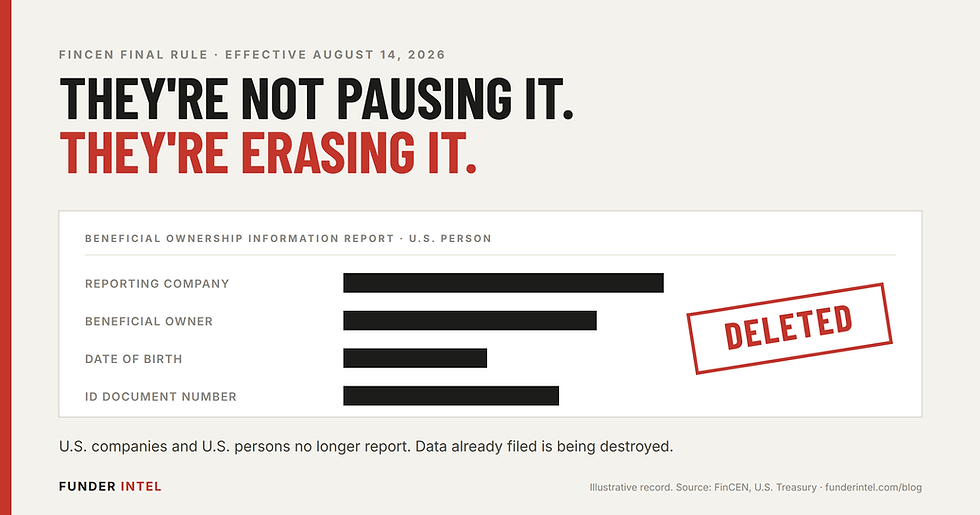
On August 11, FinCEN issued a final rule permanently removing the requirement for U.S. companies and U.S. persons to report beneficial ownership information under the Corporate Transparency Act. It took effect August 14.
The rule does four things worth knowing. It makes permanent the exemptions from the March 2025 interim rule. It releases U.S. persons who obtained FinCEN IDs from any duty to update or correct what they filed. It exempts foreign pooled investment vehicles registered here from reporting a controlling U.S. person. And it confirms that FinCEN will delete information it reasonably believes came from a U.S. person, anyone identified by a U.S. passport or driver's license, including company applicants, beneficial owners, and FinCEN ID holders.
Foreign entities registered to do business here still report beneficial ownership for foreign individuals. Everything domestic is out.
Key Terms
Beneficial owner: An individual who owns or controls 25% or more of an entity, or who exercises substantial control over it.
BOI database: FinCEN's non-public registry of beneficial ownership. It was never open to the public; access was limited to law enforcement and, with the company's consent, to certain financial institutions.
CDD Rule: The 2016 Customer Due Diligence rule requiring covered financial institutions, banks, brokers, and mutual funds, to identify and verify beneficial owners of legal entity customers. Separate from the CTA, and still in force.
The case for it
Treasury framed the rule as deregulation delivered. Secretary Bessent called it a "victory for common sense" and said the burden was being lifted from law-abiding owners without compromising national security.
The small business lobby had been pushing for years. NFIB called it a major win and put the savings at more than $128 billion in regulatory and compliance costs, while arguing Congress still needs to finish the job legislatively. NSBA's Todd McCracken was blunter, calling the CTA a burden on job creators that would do "next to nothing to actually stop money-laundering", and warning that regulatory declarations can be reversed as easily as they're issued.
That last point deserves weight. The CTA is still on the books. This is a rule interpreting it, not a repeal of it.
The compliance objections were also substantive rather than merely inconvenient. The reporting regime drew a wave of litigation and conflicting court decisions, imposed personal-identification filing duties on the smallest entities in the economy, and required updates whenever ownership shifted. AICPA had backed narrowing it to foreign companies. Some credit union and community bank voices welcomed the relief as letting institutions spend compliance dollars where risk actually is.
The case against it
Transparency advocates were unsparing. FACT Coalition's Erica Hanichak said the rule leaves the "floodgates open for criminals" laundering money through U.S. shell and front companies, arguing Treasury walked away from a mandate Congress had given it. Transparency International's U.S. office made the same argument in harsher terms, describing anonymous American companies as getaway vehicles for illicit wealth.
The structural criticism is harder to wave off than the rhetoric. The CTA was passed in 2021 specifically because anonymous U.S. entities were a known weak point in global anti-money-laundering architecture. The United States is now, by design, less transparent about domestic company ownership than it was in 2024, and the data already collected is being destroyed rather than retained. Peer jurisdictions have moved the other direction.
There's also a practical wrinkle for banks. The CTA had directed Treasury to revise the CDD Rule so institutions could lean on the federal registry to satisfy their own beneficial ownership obligations. That never happened, and now the registry won't exist for domestic entities. As American Banker reported, this removes a tool banks had hoped to gain while leaving their obligation to identify legal entity owners fully intact.
Compliance specialists quoted in that coverage noted banks always built ownership pictures themselves, because the registry was designed around law enforcement rather than institutional due diligence.

Don't assume the states backfill this
This is the part most coverage is getting wrong, and it matters if you place deals across state lines.
New York's LLC Transparency Act took effect January 1, 2026, and is widely described as a state-level CTA. But it defines "reporting company" and "beneficial owner" by direct reference to the federal CTA and its implementing regulations. When FinCEN narrowed those definitions, New York's scope narrowed with them automatically. On December 31, 2025, the New York Department of State confirmed the Act reaches only LLCs formed outside the United States that are authorized to do business in New York. Amendments that would have extended it to U.S. persons did not survive.
So the most prominent state transparency law in the country currently does roughly what the federal rule does. Check any state regime against its actual current scope before assuming a gap is covered.