There's a Business in Your City That Banks Won't Touch. This Revenue Based Financing Fund Exists to Change That.
Apr 21
4 min read
Picture a woman. She's been running her IT services company for eleven years. She has government contracts. She has a team of fourteen. She has a revenue line that most startup founders would trade their equity for twice over.
She walks into a bank and asks for a growth loan.
They ask about her collateral. She doesn't own the building, she leases it. They ask about her credit history. It's fine, but it's not the profile of someone who's been moving institutional capital her whole career, because she hasn't been; she built something from the ground up in a city that isn't San Francisco or New York, and she did it without a network of warm introductions and angel investors who went to the same schools. They tell her they'll get back to her.
They don't.
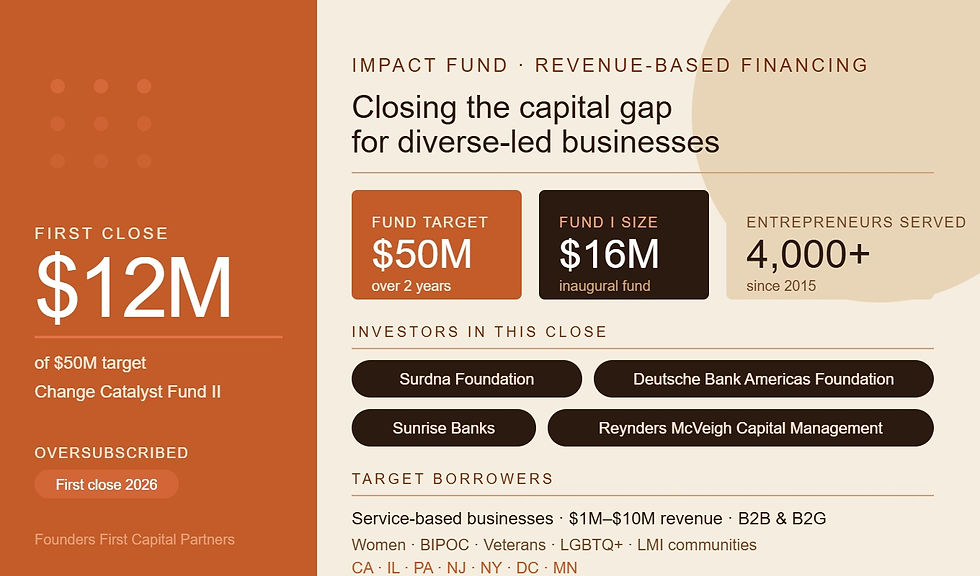
She's not a hypothetical. She's the exact founder that Founders First Capital Partners was built for, and this week, the San Diego-based firm announced the first close of its second Change Catalyst Fund, raising $12 million toward a $50 million target, oversubscribed, with some of the most credible mission-driven investors in the country writing checks.
The System Isn't Broken. It Was Built This Way.
Here's the thing that gets lost when people talk about the "funding gap" for diverse entrepreneurs: it's not a glitch. It's a feature.
Traditional bank lending was designed around collateral, credit history, and personal networks, systems that accumulated over generations of concentrated wealth. Venture capital was designed around moonshot bets on tech founders who already knew the right people. Neither of those models was ever going to work for a Black woman running a workforce development firm in Philadelphia, or a Latino veteran who built a logistics company in New Jersey, or a lesbian entrepreneur running a marketing services business in Chicago.
These founders keep getting told they're not "bankable." What that really means is that the bank's model doesn't fit them, not the other way around.
Founders First Capital Partners, led by Kim Folsom, herself a serial entrepreneur who founded seven companies and raised capital in rooms where she was routinely the only one who looked like her, was built on a different premise. If the model doesn't fit the founders, build a different model.
Revenue-Based Financing: Capital That Actually Makes Sense
The instrument at the center of what Founders First does is revenue-based financing. No equity. No ownership stake. No dilution. No investor taking a board seat at your company and telling you what your business should look like.
Instead: a non-dilutive loan, repaid as a fixed percentage of monthly revenue, up to a predetermined cap. When revenue is strong, you pay more. When business slows, payments flex down. You keep control. You keep ownership. You build wealth.
For a B2B service business with government contracts and predictable recurring revenue, which is exactly the profile Founders First targets, this structure fits like it was designed for them. Because it was.
The fund targets companies generating between $1 million and $10 million in annual revenue. Not pre-revenue startups chasing venture scale. Not established mid-market companies with investment-grade financials. The businesses in between, the ones that are too real and too successful to be ignored, but still too "different" for the traditional system to accommodate.
What $12 Million Oversubscribed Actually Means
Let's be honest about what fundraising looks like in 2026. Impact-labeled funds are everywhere. The word "underserved" appears in so many pitch decks it has started to mean nothing. LPs are more skeptical, not less.
So when a fund like this closes oversubscribed, when more capital came in than they were asking for, that's not a press release talking point. That's the market making a statement about track record.
Founders First has been doing this since 2015. They've served more than 4,000 entrepreneurs. They've deployed capital through their inaugural $16 million Change Catalyst Fund. The businesses they back report real results, revenue growth, job creation, staying power through economic disruption.
The investors who showed up for this second close aren't naive: Surdna Foundation came in as a first-loss investor, meaning they absorb losses before anyone else does, specifically to attract more commercial capital into the stack. Deutsche Bank Americas Foundation wrote a check. So did Sunrise Banks, a community bank that used the fund as a way to extend its mission beyond what its own balance sheet could reach. Reynders McVeigh Capital Management, which co-designed the first fund, came back.
These aren't donors. They're investors with fiduciary obligations who looked at the data and decided this was a good bet.
The Cities on the Map Tell the Story
Founders First will deploy capital across California, Illinois, Pennsylvania, New Jersey, New York, and the Washington D.C. metro area, and in Minnesota, through a specific partnership with Sunrise Banks to reach underserved businesses in the Twin Cities.
Read that list and think about what those cities have in common. They are majority-minority cities in many cases. They are cities with enormous concentrations of service-based small businesses, staffing firms, IT services companies, professional services providers, that generate billions in economic activity and create tens of thousands of jobs. And they are cities where the traditional capital infrastructure has consistently, systematically, underweighted those businesses.
The geographic focus isn't charity. It's where the pipeline is deepest, because the need has been greatest and the existing alternatives have been thinnest.
"When Our Founders Succeed, We Succeed."
That line is on Founders First's website, and it's the kind of thing that sounds like marketing until you understand the structure. In revenue-based financing, the funder only gets paid when the business performs. There are no fixed monthly payments that keep coming regardless of whether the business is having a hard quarter. The model literally aligns the incentive of the capital provider with the success of the founder.
That's not a coincidence. It's the whole point.
Kim Folsom built this firm because she was that founder once, capable, successful, proven, and still not fitting the mold that traditional capital required. The fund she's raised is her answer to every banker who ever told a founder like her to come back when she looked different on paper.
Twelve million dollars in. Thirty-eight million to go. And behind it, thousands of businesses that have been building real things in real cities, waiting for capital that actually fits.