


The Gotti Name Got Him In Every Room. This Time, It May Have Helped Him Out of One.
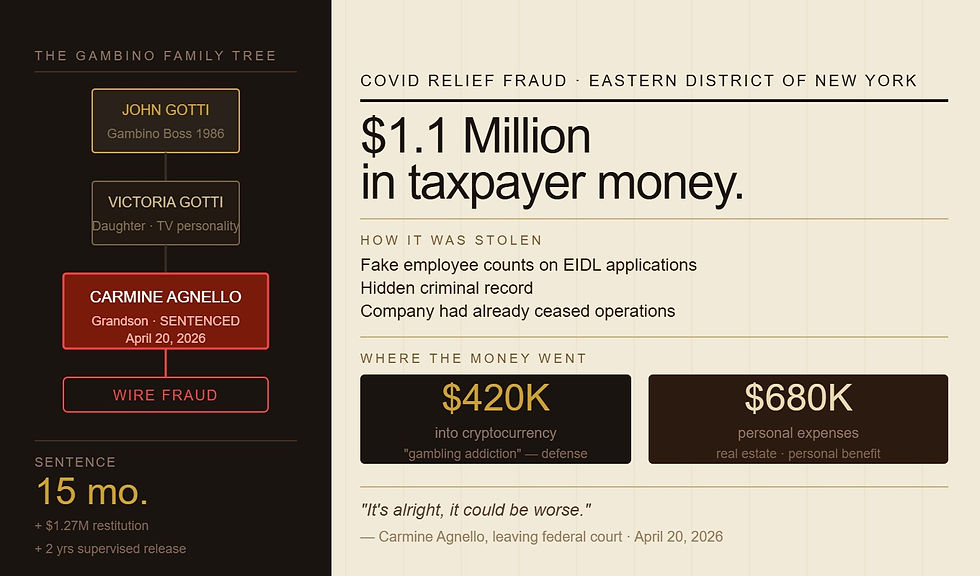
Carmine Agnello walked out of federal court on Long Island last Monday with 15 months in prison and a quote that said everything: "It's alright, it could be worse."
He wasn't wrong. It could have been a lot worse. And for most people who did exactly what he did, or less, it was.
Agnello, 39, grandson of Gambino crime boss John Gotti and onetime reality TV personality, was sentenced April 20 for stealing $1.1 million in COVID-19 Economic Injury Disaster Loans and funneling $420,000 of it into cryptocurrency. The case was straightforward: he filed at least three fraudulent EIDL applications through Crown Auto Parts & Recycling LLC, a Queens-based company that had already ceased operations before he secured most of the funds. He falsified employee counts, concealed prior convictions, and misrepresented how the money would be used.
Federal prosecutors in the Eastern District of New York asked for 33 to 41 months. Judge Nusrat Choudhury gave him 15.
Put that number next to the broader landscape of COVID fraud sentencing, and it stands out.
What 15 Months Actually Looks Like Against the Data
Defendants sentenced in 2024–2025 receive prison terms 40% longer on average than those sentenced in 2021–2022 for identical conduct. The era of pandemic-era leniency is over, and judges across the country have made that clear. So what does the sentencing data actually show for schemes in Agnello's range?
Derek James Acree, a Florida attorney who fraudulently obtained $1.6 million through EIDL and PPP loans and spent the money on jewelry, travel, and boat repairs, was sentenced to 41 months in prison. Nearly three times what Agnello received, for a scheme that was $500,000 larger.
Tracy Emery Smith received 37 months for PPP fraud involving $694,000, less than two-thirds of what Agnello stole.
Two brothers in Georgia and Florida received 27 and 30 months respectively for a $1.6 million COVID fraud scheme involving fabricated tax documents and fake employee counts, the same playbook Agnello ran, for a larger amount, with sentences nearly double his.
In June 2025, Richard Nieto got 46 months for fraudulently obtaining $913,000 in PPP loans, $200,000 less than Agnello's haul, and three times the prison time.
Lakesha Bowles received 30 months for her role in a $1.5 million COVID fraud conspiracy.
Even the lower end of the comparison is striking. A Texas man was sentenced to six years in federal prison for fraudulently obtaining more than $400,000 in EIDL loans, less than half of Agnello's scheme, four times the sentence.
Fifteen months starts to look less like a sentence and more like a discount.
Sale
CAPITAL AFTER HOURS
May 14, 2026, 6:30 – 8:30 PMThe Federal
TICKETS
What Tipped the Scale
Two things appear to have moved the needle for Judge Choudhury.
The first was Agnello's guilty plea in September 2024 and his courtroom statement. "It was wrong, selfish and criminal," he told the judge. "I carry a great deal of guilt and shame for my actions." Federal judges do give weight to genuine acceptance of responsibility, and Agnello's attorney Jeffrey Lichtman argued that his gambling addiction, extended to cryptocurrency speculation, was a clinical pattern he had since addressed through treatment.
The second was more unusual. Agnello told the judge his mother, Victoria Gotti, was seriously ill and needed a kidney transplant — and that he was her intended donor. The judge said she took that into consideration. Prosecutors pushed back hard, arguing that the kidney donation hadn't yet occurred and shouldn't factor into sentencing. The judge disagreed.
Prosecutors had argued for 33 to 41 months. They got less than half of their low end.
The "Pay Now, Chase Later" System — and Its Uneven Consequences
None of this happens without a system that was designed for speed over scrutiny. Cybercrime consultant David Sehyeon Baek noted that the government prioritized speed over verification, creating a "pay now, chase later" environment. That environment is why a man with a criminal record, a defunct business, and fabricated employee figures walked away with $1.1 million in taxpayer money without triggering a single red flag in real time.
The SBA OIG estimated that 8% of total PPP disbursements, approximately $64 billion, were fraudulently obtained. EIDL fraud estimates run even higher, with some projections reaching $236 billion across pandemic relief programs. The government has been chasing that tab ever since, and the sentencing data reflects an enforcement apparatus that has steadily hardened its posture as the cases have piled up.
Agnello's sentence runs against that trend.
The Name in the Room
There were no RICO allegations, no money laundering charges, and no public suggestion of broader organized crime involvement, a significant absence given the Eastern District's institutional familiarity with Gambino prosecutions.
The DOJ treated this as a wire fraud case. Nothing more.
But it's hard to ignore the question entirely. The name Gotti carries a certain weight in a federal courthouse in New York, the same courthouse system that spent decades trying to put his grandfather away. Whether that weight worked for or against Carmine Agnello in that courtroom on April 20 is something only the judge knows.
What we do know is that he walked out the door 18 to 26 months lighter than the prosecutors wanted, and considerably lighter than what comparable defendants have received in recent years.
"It's alright," he said. "It could be worse."
For most people who did what he did, it was.