

Wafra Navitas acquisition: A Bank Sells Its Equipment Lender, and Private Capital Steps In
Wafra is buying Navitas Credit from United Community Bank for ~$1.9B. Why a bank sold its equipment lender to private capital, and what it signals.

The most revealing detail in Wafra’s $1.9 billion deal for Navitas Credit isn’t the price. It’s the financing.
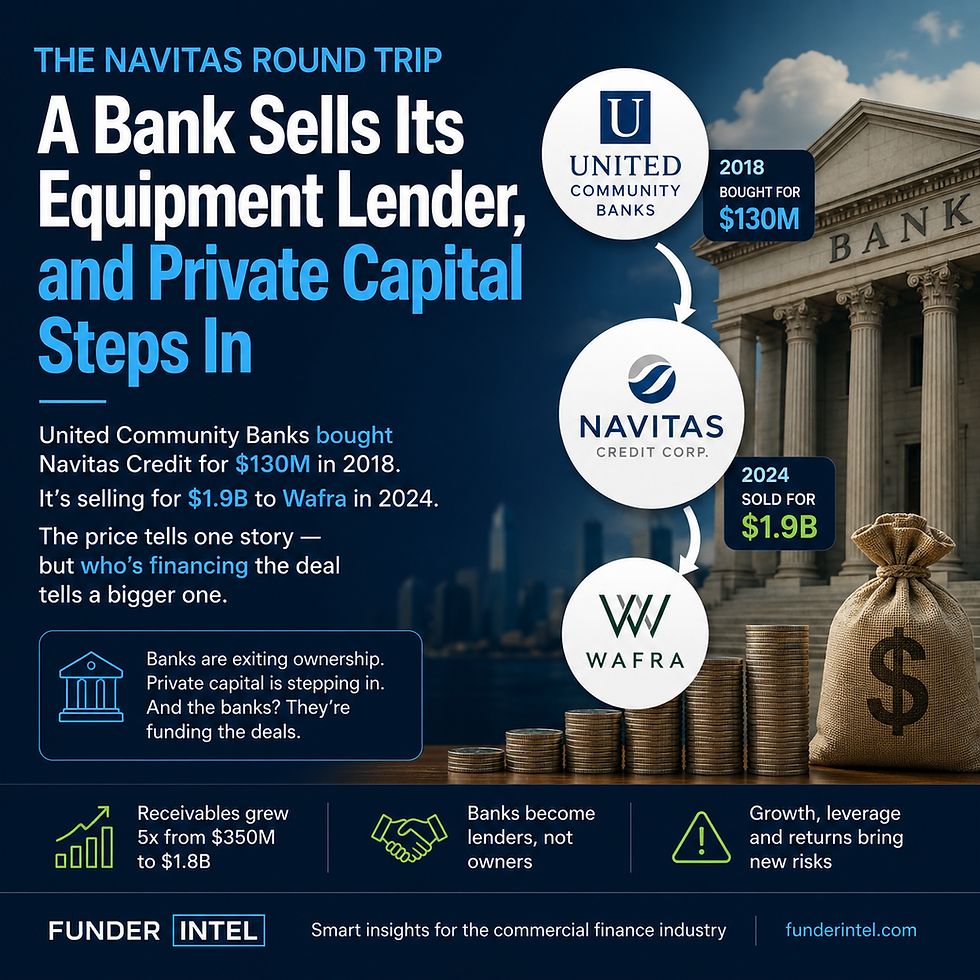
When the New York alternative asset manager announced that it would buy Navitas, the Ponte Vedra, Florida, equipment finance company, from United Community Banks, two familiar names turned up in the fine print: Bank of America and Wells Fargo, providing the acquisition financing plus another $1 billion of capacity to fund Navitas’s growth. Read that twice. The banks aren’t buying the lender. They’re lending to the asset manager, that is. In a single transaction, you can watch the reordering of who owns small business credit in America, and who is content to merely fund it.
The Deal
The Wafra Navitas acquisition terms, announced June 12: investment funds advised by Wafra, a roughly $30 billion alternative asset manager long associated with Kuwaiti institutional capital, will acquire Navitas from United Community Bank for approximately $1.9 billion in cash, subject to closing adjustments. Founded in 2008, Navitas finances essential-use, small-ticket equipment for small and mid-sized businesses nationwide, and held about $1.8 billion in owned receivables as of March 31, with more than 200 employees across six locations. CEO Mike Bruman and his team stay on; the deal is expected to close in the third quarter. (Details via the companies’ announcement and Equipment Finance News.)
At roughly 1.05 times owned receivables, the headline number is a measured premium, not a frothy one. The drama is in the trajectory, not the multiple.
The Round Trip
Rewind to January 2018. United, then a roughly $12 billion-asset bank, agreed to buy Navitas’s parent for about $130 million in cash and stock. Navitas at the time carried some $350 million in loans and leases. The logic was straightforward and, frankly, sound: pair a fast-growing equipment finance platform with a bank’s cheap, sticky deposit funding and watch the margins compound. It worked. Eight years later, the receivables book is roughly five times larger, and the platform is changing hands for about fifteen times what United paid.
So here is the puzzle worth sitting with. If owning Navitas was such a winning trade, and the numbers say it was, why would a bank sell it now, to a private capital manager, rather than keep compounding? The answer is the whole story.

Why the Bank Sells
Banks have spent the past two years quietly reconsidering what belongs on their balance sheets. Equipment finance is capital-intensive: every contract consumes regulatory capital and balance-sheet capacity that, under a tougher post-2023 supervisory mood, banks would rather hold against their core franchise. Selling a high-performing, fully valued specialty unit lets a bank crystallize years of value creation in one clean gain, free up capital, and simplify its story for investors and regulators. The same deposit-funding advantage that made owning Navitas attractive in 2018 matters less when funding costs have normalized, and capital is the binding constraint. None of this requires Navitas to be troubled; quite the opposite. A bank sells its best non-core asset precisely because that is what fetches $1.9 billion.
Why the Asset Manager Buys
On the other side of the table sits the defining capital-markets trend of this decade: the migration of lending out of banks and into private, asset-based finance. Alternative managers, backed increasingly by insurance and other long-dated, permanent capital, are hungry for exactly what Navitas produces: granular, collateralized, short-duration receivables that throw off steady yield. An equipment finance platform is, from that vantage, a machine for manufacturing the kind of paper these investors need. It’s the same institutional appetite we’ve tracked in the wave of small-business securitizations, only here the investor is buying the originator outright.
Bruman, the Navitas CEO, named the motive plainly: the company’s “growth trajectory and ambitions called for a different capital structure.” Translated, that means freedom from a bank’s capital rules and the ability to leverage an equity base with a dedicated $1 billion facility from BofA and Wells. Under an asset manager, a platform like Navitas can chase growth a regulated bank parent would have throttled.
What the Wafra Navitas acquisition Signals
For anyone originating or brokering small business and equipment finance, the takeaway is structural. The ownership of origination platforms is moving from banks to asset managers, while the banks reposition one rung up the capital stack, as the senior, secured lenders to those platforms rather than their owners. Expect more of it: carve-outs of bank-owned specialty units, take-privates of independent lenders, and funders whose ultimate owner is now a fund with a five-to-seven-year clock and a growth mandate. That can be very good for the channel, more capital, a more aggressive product, and partners eager to deploy. It also changes the temperament of the money behind your funder.
The Case for Caution
Because that temperament cuts both ways, private-capital ownership rewards growth, and growth funded by leverage is wonderful until the cycle turns. A granular, small-ticket equipment book is resilient, but it has not been stress-tested at today’s scale under asset-manager ownership and acquisition leverage at the same time. “A different capital structure” is also a more demanding one: it expects returns, it has a horizon, and it is less forgiving than a deposit base when losses tick up. As more of the sector consolidates under a handful of large capital pools, the resilience of small business funding will increasingly track the discipline, or impatience, of those owners.
The Bottom Line
The Navitas round trip, $130 million in, $1.9 billion out, with two money-center banks happy to finance the next owner rather than be it, is the clearest snapshot yet of where this is all heading. The question for the channel is no longer whether private capital is taking over the plumbing of small business lending. It is what kind of owner you want standing behind your funder when the cycle finally turns.